


Hidden or visible, how disability transcends golf
- Elle McHale

- Sep 27, 2022
- 7 min read
Updated: Oct 4, 2022
John Simpson MBE was left with a weak left leg after catching polio in 1954 at the age of two. After a decade of struggling, thirteen-year-old Simpson spent a year in hospital. Two big operations later he was released with a brace on his left leg. Growing up in Kent, he was eager to play outside with his friends once again. He followed them up an eight-foot wall and watched as they walked across it. Confident he could do the same, he stood up and began to walk on top of it.

His mother, who was watching with wide eyes, shrieked for his father. A young and naive Simpson assumed it was to watch him, although looking back he understands she was terrified of the damage he could have done had he fallen.
Sprinting outside, his father assessed the situation and pulled his mother back, looked at Simpson and gave an encouraging nod.
“As a parent that’s quite something to be able to do, I don’t know whether I could have done that,” reminisced Simpson as he sat back.
“It gave me a chance,” he added, after reflection.
Shortly after, a doctor took Simpson and his father out to play golf. Once the game was over, the man lifted his trouser to show Simpson he too was an amputee. This shocked Simpson as he walked with ease across a range of terrains seemingly without effort.
Suddenly, it occurred to him that golf provided a level playing field for disabled people to play with able bodied individuals due to the official handicap system.
A triple amputee could go up to Tiger Woods asking for a game.
This prompted Simpson to create the On Course Foundation (OCF) in 2010, a non-profit organisation seeking to support the rehabilitation of service personnel and veterans in the U.K. and United States through the game of golf and providing employment in golf related industries.
Golf works the core and limb coordination so plays a crucial role in the physical rehabilitation of players. Alongside an abundance of concentration, camaraderie and competitive spirit, which has supported psychological recovery by restoring self-confidence and providing a sense of purpose after injury.
Despite wearing a brace in his left leg, Simpson continues to play golf regularly.
On one occasion, Simpson was playing with someone who worked for the British Military Rehabilitation Centre. He asked Simpson to speak to the veterans about golf at Headley Court in 2009, which inspired him to create the OCF.
Upon entering the room, he was greeted with a room of staring faces. Still bodies sat in silence, some of whom were missing limbs. Some girls, majority guys, but all “youngsters”.
“When I saw what I saw, I thought being disabled myself and knowing what golf had done for me. I thought, I'm in a great position to start something here,” reflected Simpson.
Sitting upright in the front row was, Gregg Stevenson, nodding along to Simpson’s speech his gaze remained wholly fixated on Simpson.

Simpson said: “He looked at me as though to say, I think I could do this.”
After the talk, the room emptied and Simpson got a chance to speak to him one-on-one, he was in a wheelchair with no legs, at this point prosthetics had not been fitted.
He was a young man with no legs and a few other injuries, knowing his future was no longer going to be in the military once the rehabilitation and operations procedure had finished but became one of the OCF’s first members.
With a background career managing professional golfers, Simpson was in a good position to trial the idea of such a charity, where they would rehabilitate military personnel through the game of golf.
To test the idea, they carried out a pilot scheme with 10 injured servicemen. They brought in a professional and several coaches to introduce them to chipping and putting as they were all new to golf, before moving to the practice range.
By the end of the first morning, every player hit the wow shot.
As Simpson says: “In golf, if you hit that shot, it’s got you”.
The charity has now reached nearly 1000 members in the UK, of those over 200 have found employment or work experience through the foundation in golf related industries.
The beauty, as Simpson describes it, of this programme is that people are trained to such a high level that they can then pass on their knowledge and love for the game to the new men and women coming in, and so a cyclical and long-lasting charity has been established.
The foundation provides something for everyone, some find employment in golf industries, others become ambassadors and some even go pro.
Without the foundation, many have described that the alternative route could have led to a very depressed future.
Adjusting back into society can be extremely challenging and daunting for some.
The 2021 National Veteran Suicide Prevention Annual Report stated that more veterans die from suicide than in combat.
A member of OCF told Simpson that he “had it all arranged”, so for many not only is this charity life changing but it is also lifesaving.
One of the OCF’s pivotal aims is to help members become comfortable with their new lifestyles, whether they are suffering from a physical or mental disability.
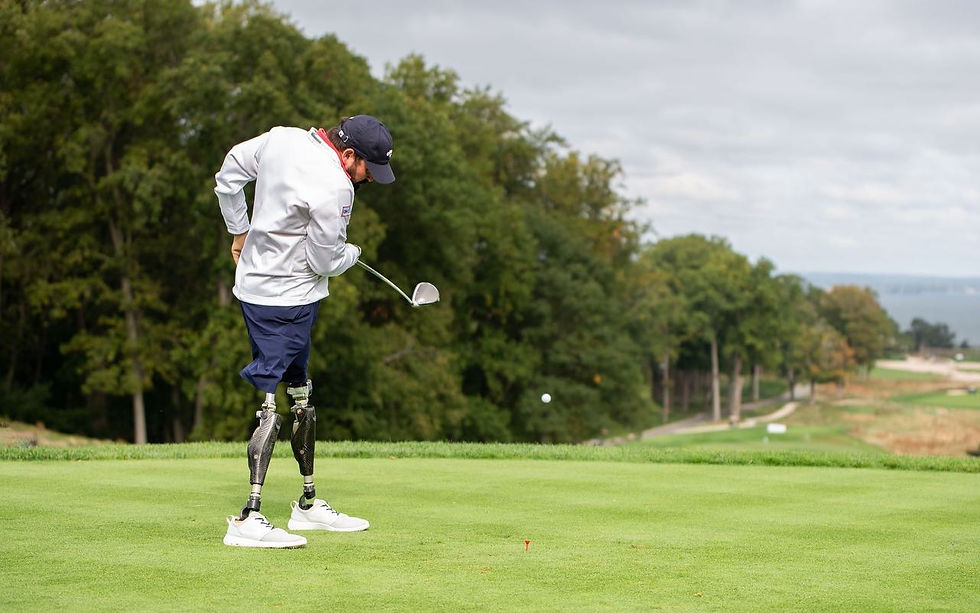
Rehabilitation centres occasionally order people to visit the OCF and Simpson says you can see them looking frustrated to be there and wondering why they are there until you have someone like Ian Bishop walk out. An ex royal marine, a double leg above knee amputee, who casually stands up and hits a ball well over 200 yards down the middle of the fairway.

The epitome of proving the impossible is Tom James. He was 19 when he was blown up by an IED. He lost his right eye, his entire right arm, severely damaged his leg but was able to keep it and only has one whole finger, half a finger and half a thumb on his left hand. And yet, here he is playing on Donald Trump’s golf course in Aberdeen, one of the toughest links courses in Scotland, hitting over 200-yard shots.

Nick Kimmel is another shining member of the OCF. During his second tour of Afghanistan Kimmel landed on 40lbs of homemade explosives during a mission. Even though only 13lbs detonated, it instantly took off both his legs from above the knee and his left arm from above the elbow. After his injuries, he returned to the golf course. Now, he has a handicap of 18.
THE SIMPSON CUP:

The Simpson Cup was set up to increase awareness and raise funds for the On Course Foundation and provide its members with a new way to represent their countries again.
Launched in 2012, this Ryder Cup-style tournament pits 13 injured service personnel from both the UK and USA against one another. All competitors are members of the OCF.
The competition takes place every year, alternating between the UK and America. As a result, the OCF has offices based in London and Florida (USA).
With his background at the International Management Group (IMG), where Simpson managed clients such as: Sir Nick Faldo, Greg Norman and Bernard Langer, who have won 10 majors between them.
Simpson strived to ensure the cup took place at the best golf courses, the most recent cup was held at The Creek in 2021.
The tournament has been hosted by many other world-renowned venues including: TPC Sawgrass, Royal Lytham & St Anne’s, Congressional Country Club, Royal St George’s Golf Club and the home of golf, St Andrews.
Next week, the Simpson Cup will celebrate its tenth anniversary at the Baltusrol Golf Club in New Jersey from August 28-31.
This celebration of the unexpected journeys that took people from representing their country, as a service member, to representing their country as an athlete.
"When you see a guy, who can't even look at you when you first meet him because he’s feeling that down about life and you see him work his way, in golf, to a point where he is representing his country, it's amazing,” Simpson proudly stated.
This transcends to the camaraderie you see between the British and the US team because, as one of the players exclaimed: “We fought together, we've been injured together, and some of us have died together. Then we never see each other again. But now we are all back together.”
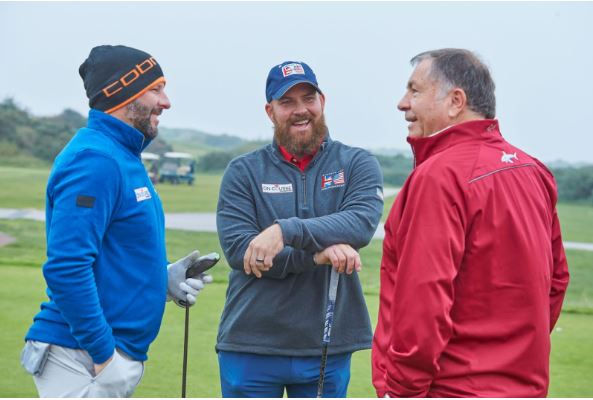
Mike Browne, a former British soldier, and Chad Pfeifer, a former US Army veteran, are two key examples of this. Both have made a career out of golf as professionals, despite both being single leg amputees from above the knee. They often play against each other at the Simpson Cup, this August is no different.
Looking forward, Simpson is hoping to expand his charity to other areas of disability.
With the hopes of increasing access to sport for disabled people, Simpson is planning to invite young people, whether they are newly disabled or were born with a disability, to say “watch this”.
To show them what is possible, as opposed to telling them.
“Thinking back,” Simpson said with one arm resting on the sofa, “No one ever said to me have you thought about sport? Not one person. No one ever told me to play golf, only my father, and then, I made a career out of it.”
“I'm sure the average person still doesn't realise that if they're disabled, they could play this game at an amazing level.”
Upon reflection, Simpson explained his pride for these players, who often remind him of his younger self trying to climb that eight-foot wall: “A double amputee had to climb to the top of a hill on all fours, with a club in his hand. Even the caddy couldn’t make it up there, but he was determined. He hit an amazing shot, came down backwards on all fours and carried on like nothing had happened. To see him do that, and do it regularly, is nothing but impressive.”
Refusing to conform to societies belief that disabled and able-bodied people should play sport separately, Simpson has successfully created a charity where these service personnel are not suppressed by their injuries, whether that is physical or invisible wounds of war. Instead, they have rebuilt their lives through the game of golf and attaining employment in golf related industries.


Comments